

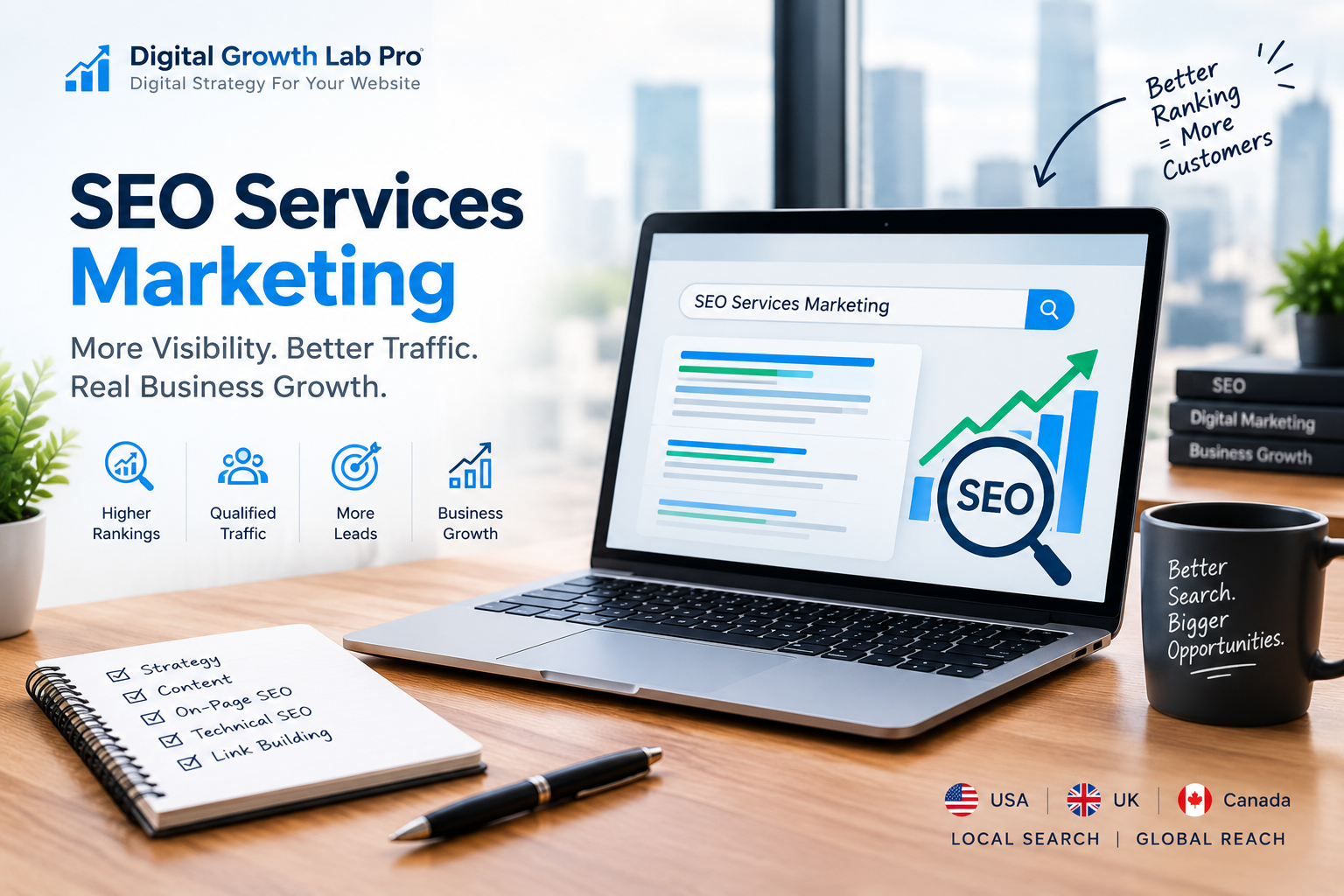
Getting a business noticed online is harder than simply having a website. Your customers may already be searching for the products or services you provide, but if your website does not appear when they search, those potential customers may never discover your business.
This is where SEO services marketing becomes important.
Search engine optimization is not just about adding keywords to a website or trying to reach the first position on Google. A well-planned SEO strategy helps search engines understand your website while making it easier for real people to find useful information, evaluate your business, and take action.
For business
Getting a business noticed online is harder than simply having a website. Your customers may already be searching for the products or services you provide, but if your website does not appear when they search, those potential customers may never discover your business.
This is where SEO services marketing becomes important.
Search engine optimization is not just about adding keywords to a website or trying to reach the first position on Google. A well-planned SEO strategy helps search engines understand your website while making it easier for real people to find useful information, evaluate your business, and take action.
For businesses in the USA, UK, and Canada, effective SEO can be particularly valuable because customers often use search engines to compare local businesses, research services, read reviews, and decide which company to contact.
What Is SEO Services Marketing?
SEO services marketing refers to using search engine optimization as part of a broader marketing strategy to increase a business’s visibility in organic search results.
Unlike paid advertising, organic search traffic does not require a business to pay for every click. Instead, SEO focuses on improving different areas of a website so that relevant pages can be discovered, understood, and potentially ranked for searches related to the business.
A professional SEO services marketing strategy can include:
- Keyword research
- On-page SEO
- Technical SEO
- Content optimization
- Internal linking
- Website structure improvements
- Local SEO
- Competitor research
- Search performance monitoring
- Authority and backlink development
- Conversion-focused content
The exact combination depends on the business, industry, competition, and target market.
Why SEO Matters for Modern Businesses
Imagine someone in New York searching for a service your company provides.
They see several businesses in the search results. If your website is not visible, the customer is unlikely to scroll through pages of results looking for you.
The same situation applies to a business targeting customers in London, Toronto, Vancouver, Los Angeles, Chicago, Manchester, or other competitive markets.
SEO helps businesses build visibility around the searches that matter to them.
Google explains that SEO helps search engines understand website content and helps users find websites through search. It also emphasizes that there are no guaranteed shortcuts to achieving a particular ranking position.
That is why sustainable SEO should focus on improving the website rather than chasing quick ranking tricks.
SEO Services Marketing Is More Than Keywords
Keywords are important, but modern SEO involves much more than placing a phrase repeatedly throughout an article.
For example, suppose a company wants to rank for a service such as:
SEO services marketing
Simply repeating that keyword dozens of times would not create a useful page.
Instead, the page should answer the questions a potential customer may have:
- What does SEO actually involve?
- Which SEO services does a business need?
- How can SEO increase qualified website traffic?
- How long does SEO usually take?
- What should a business look for in an SEO provider?
- How can SEO performance be measured?
- Is local SEO important for a service-area business?
This approach creates content for people first while still giving search engines enough context to understand the topic.
Google specifically recommends creating helpful, reliable, people-first content rather than content primarily designed to manipulate rankings.
Key Components of an Effective SEO Strategy
1. Keyword Research
Every SEO campaign needs to understand what potential customers are searching for.
Keyword research involves identifying relevant search terms based on factors such as:
- Search intent
- Relevance to the business
- Competition
- Geographic location
- Customer needs
- Commercial value
For a business targeting the United States, the strategy may focus on nationwide searches as well as individual states and cities.
A UK business may need to consider searches across England, Scotland, Wales, and Northern Ireland.
For Canadian businesses, location can also be important because search behavior may differ between markets such as Toronto, Vancouver, Calgary, Montreal, and other regions.
The goal is not simply to collect hundreds of keywords. The goal is to understand which searches can bring the right people to the business.
2. On-Page SEO
On-page SEO focuses on the elements that appear on your website.
This can include:
- Page titles
- Meta descriptions
- Headings
- Content structure
- Image optimization
- Internal links
- URLs
- Keyword relevance
- Search intent
- Calls to action
A well-optimized page should make sense to both visitors and search engines.
Google also recommends using words that people would naturally use when looking for your content and placing relevant information in descriptive areas such as titles, headings, alt text, and link text.
3. Technical SEO
A beautiful website can still struggle in search if search engines have difficulty crawling, rendering, or understanding it.
Technical SEO may involve checking:
- Crawlability
- Indexing
- XML sitemaps
- Robots.txt
- Canonical URLs
- Redirects
- Broken links
- Mobile usability
- Page performance
- HTTPS
- JavaScript-related issues
- Structured data
Technical SEO does not mean making a website unnecessarily complicated. In many cases, it means identifying problems that prevent search engines from properly accessing or understanding important pages.
4. Content Strategy
Content is one of the most useful ways for a business to answer customer questions and build topical relevance.
However, publishing dozens of generic articles is not necessarily an SEO strategy.
A stronger approach is to create content around genuine customer needs.
For example, an SEO company targeting small businesses might publish articles covering:
- How much does SEO cost for a small business?
- How long does SEO take to work?
- Local SEO vs national SEO
- How to choose an SEO company
- Common technical SEO problems
- How to improve organic website traffic
- SEO strategies for service businesses
Each article should provide information that is actually useful to the reader.
Google’s guidance recommends original, useful, well-organized, up-to-date content rather than copied or repetitive material.
Local SEO for the USA, UK, and Canada
If your business serves customers in specific locations, local SEO can be an important part of your marketing strategy.
For example:
USA:
A business may target searches around cities, states, or service areas.
UK:
A company may focus on cities, counties, or specific regions.
Canada:
Businesses may target provinces, cities, and local service areas.
Local SEO can involve optimizing business information, location pages, relevant website content, reviews, and other local signals.
The important point is to create location information that genuinely helps customers rather than producing large numbers of nearly identical city pages simply to target keywords.
SEO and User Experience Work Together
SEO may bring someone to your website, but the website experience can determine what happens next.
If visitors arrive and find:
- Slow-loading pages
- Confusing navigation
- Weak content
- Difficult-to-use mobile pages
- Missing information
- Unclear services
- No obvious next step
they may leave without contacting the business.
That means SEO should not be treated as an isolated marketing activity.
The website needs to work as a complete customer journey:
Search → Website → Information → Trust → Action
The purpose of attracting organic traffic is not simply to increase a number in an analytics report. The goal is to attract people who are genuinely interested in what the business offers.
How to Measure SEO Performance
A good SEO campaign should be measured using meaningful data.
Depending on the business, useful metrics can include:
- Organic clicks
- Organic impressions
- Search queries
- Average search position
- Organic landing pages
- Qualified leads
- Phone calls
- Form submissions
- Conversion rate
- Organic revenue
Google Search Console can help website owners understand how their websites perform in Google Search.
It is also important to remember that SEO results do not always appear immediately. Google notes that some changes can take weeks or months to show an impact, depending on the situation.
For that reason, SEO should generally be viewed as an ongoing process rather than a one-time task.
How to Choose SEO Services for Your Business
Choosing an SEO provider should involve more than looking at a low monthly price or a promise of instant rankings.
Before working with an SEO company or specialist, consider asking:
What exactly will you work on?
A professional should be able to explain the areas of SEO they plan to address.
How will success be measured?
The answer should connect SEO activity with meaningful business outcomes rather than relying only on ranking positions.
Will you provide regular reporting?
Clear reporting makes it easier to understand what has been completed and what is changing.
How do you approach content?
Ask whether content will be created specifically for your audience or simply produced at scale around keywords.
Do you make ranking guarantees?
Be cautious with guaranteed first-place rankings. Google itself states that there are no secrets that automatically guarantee a first position in search results.
A credible SEO strategy should focus on improvements, testing, measurement, and long-term growth.
Common SEO Mistakes Businesses Should Avoid
Some businesses invest in SEO but see limited results because the strategy is built around shortcuts.
Common mistakes include:
Keyword Stuffing
Repeating the same keyword excessively can make content difficult to read and does not create a better experience for visitors. Google specifically advises against keyword stuffing.
Publishing Content Without a Purpose
Not every business needs hundreds of blog posts.
Content should have a clear reason to exist and should answer a genuine question or solve a relevant problem.
Ignoring Technical Problems
Publishing new content will not necessarily solve problems that prevent important pages from being properly crawled or indexed.
Focusing Only on Rankings
Ranking is useful, but rankings alone do not pay the bills.
A page ranking for an irrelevant keyword may bring visitors who never become customers.
Expecting Immediate Results
SEO usually requires consistent work and monitoring. Search visibility can change over time as websites, competitors, content, and search systems evolve.
SEO Services Marketing for Long-Term Growth
The strongest SEO strategies are usually connected to the wider goals of a business.
For example, an online retailer may care about product visibility and revenue.
A local service company may care more about phone calls and quote requests.
A B2B company may focus on qualified leads and decision-makers.
An agency may want to generate leads for its clients while strengthening its own online presence.
That means SEO should begin with a simple question:
What does the business actually want from organic search?
Once that is clear, keyword research, content, technical improvements, on-page optimization, and measurement can all work toward the same objective.
Final Thoughts
SEO services marketing is not about finding a shortcut to Google rankings. It is about building a stronger connection between what people search for and what your business provides.
For businesses targeting customers across the USA, UK, and Canada, a well-planned SEO strategy can help improve search visibility, attract more relevant visitors, and create additional opportunities for leads and sales.
The most important part is to focus on the complete picture: useful content, a technically accessible website, relevant search intent, strong user experience, and consistent measurement.
At Digital Growth Lab Pro, we approach SEO with the goal of helping businesses build sustainable online visibility through practical SEO and digital marketing strategies.
If your website is not attracting the organic traffic you expect, the first step is not necessarily to publish more content. It is to understand why the website is not performing as expected and what should be improved first.
That is where a focused SEO strategy can make a meaningful difference.

Leave a Reply