

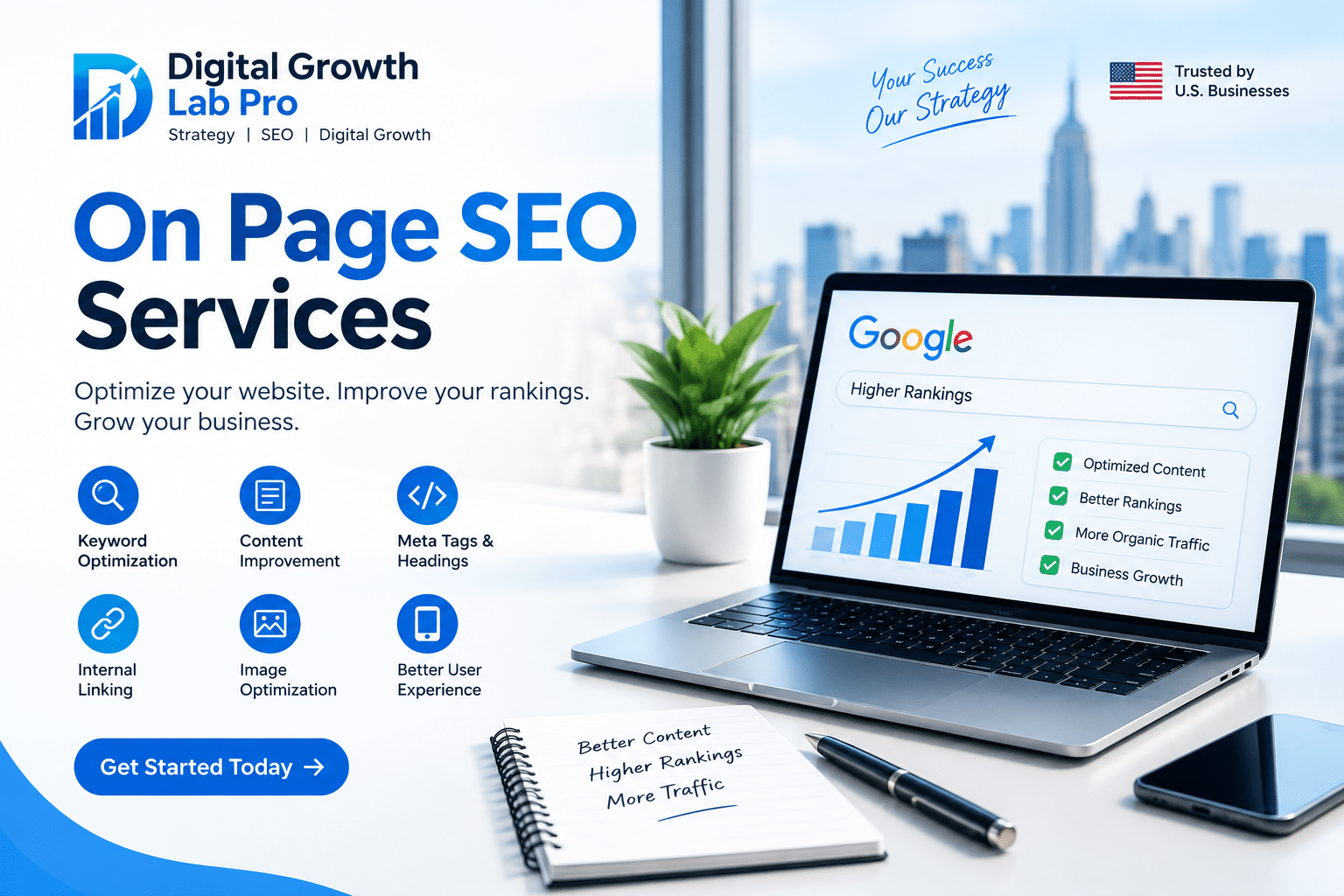
Getting your website to appear on the first page of Google can make a significant difference in how customers discover your business. However, publishing content alone is not always enough to improve your search visibility. Your website needs well-optimized pages, useful information, a clear structure, and a positive user experience.
This is where On Page SEO Services can help. By improving website content, title tags, headings, internal links, and other important page elements, businesses can make their websites easier for search engines to understand and more helpful for visitors.
At Digital Growth Lab Pro, we believe effective on-page SEO starts with understanding your audience and creating a website experience that meets their needs. Whether you run a local business, an e-commerce store, or a B2B company in the United States, optimizing your website can help you build stronger organic visibility and attract more relevant visitors.
What Are On Page SEO Services?
On-page SEO services focus on optimizing the elements within individual website pages to help search engines understand their content and connect them with relevant searches.
Unlike off-page SEO, which involves activities such as earning backlinks and building external authority, on-page SEO concentrates on improvements you can make directly to your website.
Professional on-page optimization may include:
- Keyword research and search intent analysis
- SEO-friendly title tags and meta descriptions
- Content optimization and heading structure
- Internal linking between relevant pages
- Image optimization and descriptive alt text
- URL structure improvements
- Mobile usability and page experience enhancements
- Identifying and improving content gaps
These improvements help create pages that serve users effectively while making the website’s subject matter clearer to search engines.
How Can On Page SEO Services Improve Your Google Rankings?
Improving organic search visibility requires more than adding keywords to a page. A successful strategy combines relevant content, useful page structure, and a website experience that supports the visitor’s needs.
Here are several ways on-page optimization can support your SEO performance.
Optimize Website Content for Relevant Keywords
Keyword optimization helps search engines understand what your page is about and which search queries it may be relevant to.
For example, a U.S. business searching for ways to improve its website visibility might look for terms such as “on-page SEO services,” “website content optimization,” or “SEO for small businesses.”
Effective optimization involves identifying relevant terms and incorporating them naturally into your content, headings, title tags, and other appropriate page elements.
However, using a keyword repeatedly does not automatically improve rankings. Your content should answer the reader’s questions, explain the topic clearly, and provide information that is useful for the intended audience.
Digital Growth Lab Pro can help businesses develop keyword-focused content that aligns with their services, audience, and SEO goals.
Create SEO-Friendly Title Tags and Meta Descriptions
Title tags and meta descriptions help communicate what a webpage offers in search results.
A clear, descriptive title can help users recognize that your page matches their needs. A compelling meta description can give them a reason to visit your website.
For example, a service page targeting on-page SEO could use a title such as:
On Page SEO Services for Better Search Visibility
Its meta description could explain how the service improves content, strengthens page optimization, and supports organic traffic growth.
Each important page should have a relevant, descriptive title and a useful meta description. Avoid duplicate titles, unnecessary keyword repetition, and misleading promises.
Google may generate a different search-result title or description based on the query and page content, so these elements should accurately reflect the page.
Improve Content Quality and Search Intent
One of the most important parts of on-page SEO is creating content that matches what people are actually looking for.
A person searching for SEO information may want to understand the process, while someone searching for an SEO provider may be comparing services and pricing. These visitors have different needs.
To align your content with search intent:
- Explain the main topic early in the article.
- Answer common questions related to the subject.
- Use clear headings to organize information.
- Include relevant examples and practical recommendations.
- Remove unnecessary repetition and outdated information.
- Provide a logical next step for readers who need professional help.
High-quality content can make your website more useful and relevant to your audience. It also helps establish your business as a credible source of information within your industry.
Strengthen Your Website’s Internal Linking
Internal links connect one page on your website to another. They help visitors discover related information and help search engines find and understand your pages.
For example, a blog post about on-page SEO could link to relevant pages covering SEO services, keyword research, technical SEO, or content marketing.
Use descriptive anchor text that explains what visitors can expect when they follow a link. Link to genuinely relevant pages rather than adding links simply to increase their number.
A thoughtful internal linking structure can also help distribute link equity across your website and make important service pages easier to discover.
Optimize Images and Page Experience
Images can improve the visual appeal of a website, but poorly optimized files may contribute to slow loading times.
Image optimization includes choosing appropriate file formats, compressing images, using descriptive filenames, and adding meaningful alt text when an image conveys useful information.
Page experience matters, too. Visitors should be able to navigate your website easily, read content on mobile devices, and interact with important buttons and forms without unnecessary friction.
Businesses should pay attention to:
- Mobile-friendly layouts
- Readable fonts and spacing
- Fast, stable page loading
- Clear navigation and calls to action
- Accessible content and image descriptions
- Core Web Vitals and other relevant performance issues
These improvements can make the website easier to use. While no single page experience factor guarantees higher rankings, a reliable, user-friendly website supports a better overall experience.
Improve Page Structure With Clear Headings
A well-organized page helps visitors scan information and find answers quickly.
Use one clear main heading that describes the page’s primary topic. Organize supporting sections with descriptive subheadings, using a logical heading hierarchy.
For a page about on-page SEO, headings might cover keyword optimization, content quality, title tags, internal linking, and image optimization.
Headings should help readers understand the content rather than serve as opportunities to repeat the same keyword. Clear organization makes longer articles and service pages easier to navigate.
Optimize for Local and Industry-Specific Searches
Businesses serving specific U.S. cities or regions may benefit from optimizing pages for their locations and service areas.
For example, a business serving customers in Chicago, Dallas, or Los Angeles can create useful, location-specific content when it genuinely offers services in those markets.
Effective local optimization may include accurate business information, relevant service descriptions, useful location pages, and a well-maintained Google Business Profile for eligible businesses.
Avoid creating multiple nearly identical location pages with only city names changed. Each page should provide meaningful information relevant to the customers it serves.
For companies operating nationally, industry-specific service pages and content tailored to different customer needs may be more appropriate than city-based pages.
What Should You Look for in Professional On Page SEO Services?
Choosing the right SEO provider involves more than comparing prices or promises of fast rankings. Look for a provider that understands your business goals and can explain how its recommendations support them.
Before selecting a service, consider these factors:
A clear optimization process: The provider should explain how it reviews your pages, identifies opportunities, and prioritizes improvements.
Content-focused recommendations: Your SEO strategy should consider content relevance, search intent, originality, and usefulness—not just keyword frequency.
Technical awareness: Even an on-page campaign should identify relevant issues affecting crawling, indexing, mobile usability, or page performance.
Transparent reporting: Look for reports that track meaningful metrics, such as organic clicks, impressions, relevant keyword visibility, and conversions where measurement is available.
Realistic expectations: SEO takes time, and results vary by competition, website condition, content quality, and other factors. Be cautious of anyone guaranteeing a specific Google ranking.
The right approach should focus on sustainable improvements rather than shortcuts that could undermine your website’s long-term performance.
How to Measure the Results of On-Page SEO
Once optimization work is complete, tracking performance helps you understand what is improving and where additional work may be needed.
Google Search Console is a useful starting point for monitoring organic search performance. You can review:
- Impressions: How often your pages appear in Google search results.
- Clicks: How many visits your pages receive from Google Search.
- Click-through rate (CTR): The percentage of impressions that result in clicks.
- Average position: A summary of your pages’ positions in search results for tracked queries.
Google Analytics can help you understand what visitors do after arriving on your website, including engagement and conversions when these events are configured properly.
Compare performance over meaningful periods and consider seasonal trends, changes in demand, and other SEO activities. Not every improvement produces an immediate ranking increase, and rankings can fluctuate.
The goal is to use reliable data to make better decisions, improve underperforming pages, and build a stronger organic search strategy over time.
Why Choose Digital Growth Lab Pro for On Page SEO?
At Digital Growth Lab Pro, we focus on practical SEO improvements that help businesses strengthen their online presence and connect with their target audiences.
Our approach considers the relationship between content, search intent, website structure, and user experience. Rather than relying on keyword repetition, we aim to identify meaningful opportunities to improve your website and support your broader business objectives.
Our digital growth services include SEO, content optimization, local SEO, digital marketing, and website design and development.
Whether you need help improving existing service pages, organizing your website content, or identifying opportunities to increase organic visibility, a focused SEO strategy can help you take the next step.
We also believe in setting realistic expectations. Search performance depends on several factors, and no ethical SEO provider can guarantee a particular Google ranking. Our focus is on making informed improvements and measuring progress using relevant performance data.
Build a Stronger Website With On Page SEO Services
On-page optimization is an important part of building a website that search engines can understand and visitors can use with confidence. From keyword research and content improvements to internal linking, title tags, and mobile usability, each element contributes to the overall quality and clarity of your pages.
On Page SEO Services can help businesses identify optimization opportunities, improve content relevance, and create a better experience for potential customers. When combined with a broader SEO strategy and consistent performance monitoring, these improvements can support stronger organic visibility over time.
If your website is not attracting the search traffic you expect, now is a good time to review its content, structure, and optimization opportunities.
Ready to improve your website’s SEO? Connect with Digital Growth Lab Pro to explore practical strategies for optimizing your website and building a stronger online presence in the U.S. market.
Visit Digital Growth Lab Pro to learn more about our digital marketing and SEO services.

Leave a Reply