

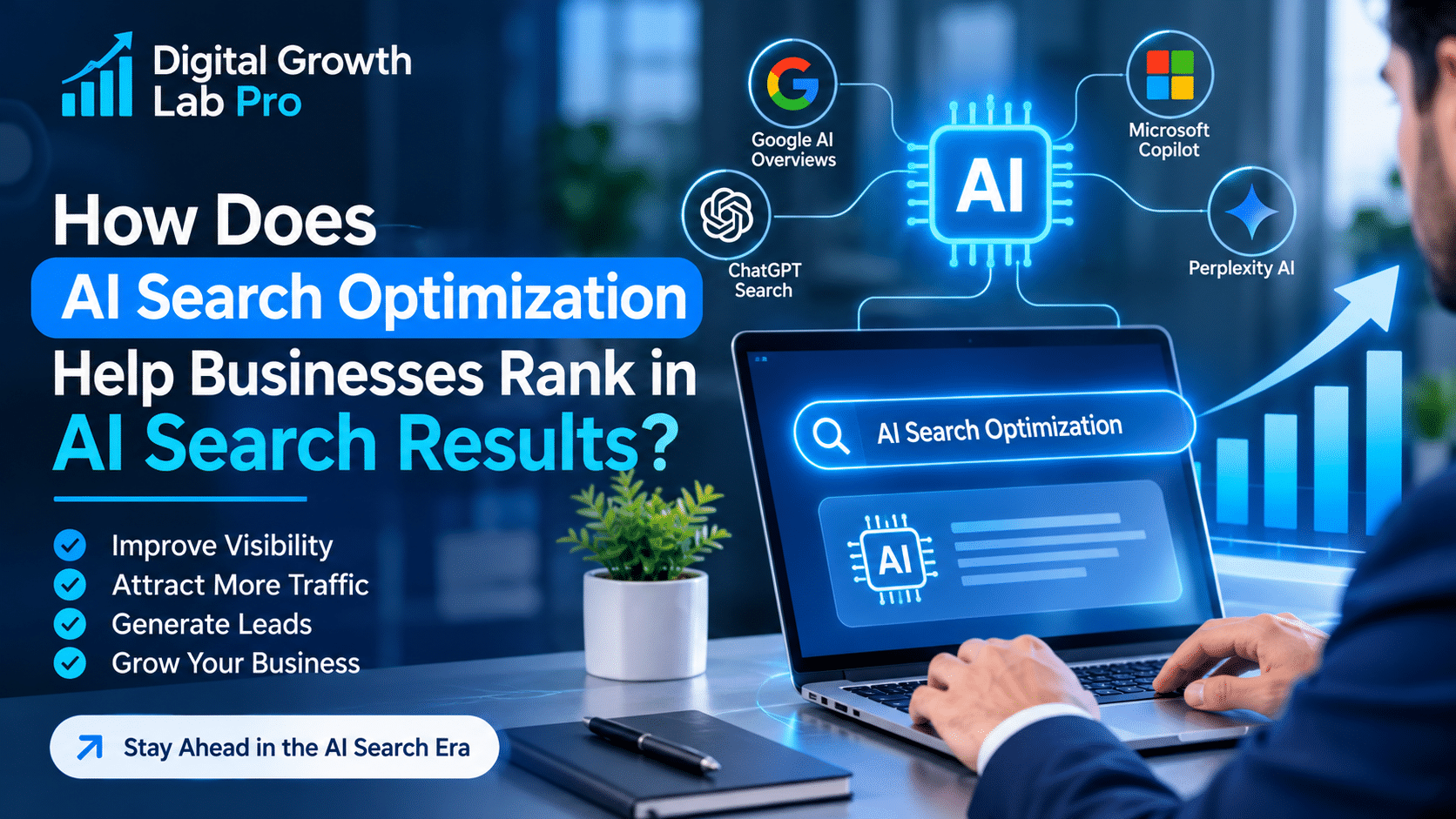
Search behavior is changing rapidly. People no longer rely only on traditional Google search results to find products, services, and business information. Today, users are also asking questions through AI-powered platforms such as ChatGPT, Google AI Overviews, Microsoft Copilot, and Perplexity.
This shift creates new opportunities for businesses that want to reach potential customers online. Instead of focusing exclusively on traditional search rankings, companies need to understand how their websites can become visible in AI-generated answers.
AI Search Optimization helps businesses improve their online presence by making website content more relevant, informative, trustworthy, and understandable for AI-powered search systems.
For businesses across the United States, adapting to this changing search environment can help build brand awareness, attract qualified visitors, and create new opportunities to generate leads.
In this guide, Digital Growth Lab Pro explains how AI search works, why optimization matters, and which strategies businesses can use to improve their visibility.
What Is AI Search Optimization?
AI Search Optimization is the process of improving website content, structure, and online authority so that AI-powered search platforms can better understand, reference, and potentially feature a business in their answers.
Traditional SEO primarily focuses on improving visibility in search engine results pages. AI search optimization expands that approach by considering how AI systems discover information, interpret questions, and generate answers.
For example, imagine someone searches:
- “What is the best SEO company for small businesses in the USA?”
- “Which digital marketing agency can help improve website traffic?”
- “How can I increase my business visibility in Google AI Overviews?”
AI-powered platforms may generate answers using information from multiple websites and sources.
Businesses with useful, relevant, and trustworthy content have an opportunity to become part of that information ecosystem.
However, appearing in AI-generated answers is not guaranteed. Each platform uses different systems to discover, evaluate, and present information.
Why Is AI Search Optimization Important for Businesses?
Online competition is becoming increasingly challenging. Businesses need more than a website to attract customers. They need a strong digital presence that helps people discover their brand across different search experiences.
Here are several reasons why AI search optimization is becoming important.
1. Improve Visibility Across AI Search Platforms
Customers are exploring different ways to find information online. AI-powered platforms can provide direct answers instead of simply displaying a traditional list of links.
Optimizing your website with clear information, relevant topics, and helpful content can improve its chances of being discovered and considered by these systems.
Businesses should focus on building visibility across platforms such as:
- Google AI Overviews
- ChatGPT Search
- Microsoft Copilot
- Perplexity AI
Each platform has its own approach to retrieving and presenting information, so a comprehensive search strategy is important.
2. Reach Customers Who Are Ready to Take Action
People often use detailed questions when researching a product or service.
For example, a business owner might search for:
“Affordable SEO services for small businesses in California.”
This type of search indicates a specific need and potentially strong purchasing intent.
By creating content that directly addresses customer questions, businesses can connect with people who are actively researching solutions.
A well-planned AI Search Optimization strategy helps align website content with the questions, problems, and interests of potential customers.
3. Build Brand Authority and Trust
Trust is an important factor in online visibility.
AI-powered search experiences aim to provide useful information from sources they consider relevant and reliable. Businesses can strengthen their digital authority by publishing accurate information, demonstrating expertise, maintaining consistent business details, and earning relevant mentions from reputable websites.
Consider publishing:
- Detailed industry guides.
- Original research and statistics.
- Expert insights and practical advice.
- Case studies and customer success stories.
- Helpful answers to common customer questions.
These resources help establish your business as a valuable source of information.
4. Create New Opportunities for Organic Traffic
Traditional search engines remain important, but AI-powered search is creating additional ways for people to discover businesses.
A website that provides valuable information may receive visitors through traditional search results, AI citations, and other discovery experiences.
Although AI visibility does not automatically translate into website traffic, it can support broader brand awareness and customer discovery.
How Does AI Search Optimization Work?
AI search optimization involves several connected activities that help search platforms understand your website and its content.
Understanding these activities can help businesses develop a stronger online strategy.
1. Content Optimization
Content remains an important part of digital visibility.
Your website should answer real questions rather than simply repeat keywords. AI systems need clear, meaningful information that explains topics accurately.
For example, instead of publishing a generic article about digital marketing, create specific resources explaining:
- How SEO helps small businesses.
- What affects Google search rankings?
- How AI-powered search changes customer discovery.
- What is the difference between traditional SEO and AI search optimization?
Use descriptive headings, short paragraphs, relevant examples, and direct answers.
2. Technical SEO and Website Structure
AI search visibility also depends on whether search systems can discover and access your website content.
A technically sound website provides a stronger foundation for organic search performance.
Important technical elements include:
- Search engine crawlability.
- Proper indexing settings.
- Mobile-friendly website design.
- Fast page loading.
- Secure HTTPS connections.
- Logical internal linking.
- XML sitemaps.
- Structured data where appropriate.
These improvements help search engines understand your website and access its important pages.
3. Semantic SEO and Topic Relevance
Semantic SEO focuses on the meaning and relationships between topics rather than relying only on exact-match keywords.
For example, a website targeting AI Search Optimization should also cover related subjects such as:
- Generative Engine Optimization (GEO).
- Answer Engine Optimization (AEO).
- Traditional Search Engine Optimization (SEO).
- AI-powered search engines.
- Search intent.
- Content authority.
Creating useful connections between these subjects helps establish topical depth.
4. Structured Data and Clear Information
Structured data helps search engines understand specific information about your website.
Depending on the content, businesses can implement relevant schema types, including:
- Organization schema.
- LocalBusiness schema.
- Article schema.
- Product schema.
- Service schema.
- BreadcrumbList schema.
Structured data should accurately represent visible page content. It does not guarantee AI citations, enhanced search appearances, or higher rankings, but it can help search engines interpret information.
5. Build a Strong Online Reputation
Your website is not the only place where customers discover your business.
Brand mentions, relevant industry publications, authoritative backlinks, business profiles, and genuine customer reviews can contribute to your overall online presence.
Focus on building a consistent reputation across relevant platforms.
Avoid buying artificial mentions or creating low-quality backlinks. Sustainable authority comes from genuine expertise and valuable contributions.
AI Search Optimization vs. Traditional SEO: What’s the Difference?
Both approaches support online visibility, but they focus on different search experiences.
| Traditional SEO | AI Search Optimization |
|---|---|
| Focuses on search engine rankings | Focuses on visibility in AI-powered search experiences |
| Targets search engine results pages | Targets AI-generated answers and citations |
| Uses keyword and content optimization | Emphasizes context, relevance, and clear answers |
| Improves organic search visibility | Expands brand discovery across AI search platforms |
| Focuses on clicks and organic traffic | Also considers brand mentions and AI visibility |
One important point: AI Search Optimization does not replace traditional SEO. Both strategies work together.
A technically healthy website, valuable content, strong authority, and relevant keywords remain important foundations for online discovery.
7 Effective AI Search Optimization Strategies for Businesses
Businesses looking to improve their search visibility should focus on strategies that deliver long-term value.
Here are seven practical approaches.
1. Understand Your Target Audience
Start by identifying the questions your potential customers ask before purchasing a product or service.
For example, a US-based digital marketing company might target questions about affordable SEO services, local search rankings, website optimization, and lead generation.
Understanding search intent helps you create content that matches customer needs.
2. Create Helpful, Question-Based Content
Develop articles that answer specific questions in a clear and informative way.
Use headings that reflect actual customer searches.
For example:
- What Is AI Search Optimization?
- How Does AI Search Work?
- Why Is AI Search Important for Businesses?
- How Can Companies Improve AI Search Visibility?
Provide direct answers before expanding into detailed explanations.
3. Strengthen Your E-E-A-T Signals
Google uses the concepts of Experience, Expertise, Authoritativeness, and Trustworthiness (E-E-A-T) in its search quality framework.
Businesses can demonstrate these qualities through:
- Accurate author information.
- Real business experience.
- Original insights.
- Reliable references.
- Transparent company information.
- Updated and fact-checked content.
These practices help readers evaluate the credibility of your website.
4. Optimize for Conversational Search Queries
People often interact with AI platforms using natural language.
Instead of searching only for “SEO services,” someone might ask:
“How can I find an affordable SEO company that helps small businesses increase organic traffic?”
Create content that addresses these longer, conversational questions naturally.
Do not force unnecessary keywords into every paragraph.
5. Improve Your Website’s Internal Linking
Internal links connect related pages and help visitors explore your website.
For example, an article about AI Search Optimization can link to relevant pages covering SEO services, content marketing, technical SEO, and digital marketing.
Use descriptive anchor text and ensure every link provides genuine value.
6. Publish Original and Updated Information
Generic content offers limited differentiation.
Businesses should create content based on real experience, original research, industry knowledge, and useful examples.
Review important pages regularly to update outdated information, statistics, and recommendations.
7. Monitor AI Search Visibility
Track how your brand appears across traditional and AI-powered search experiences.
Monitor relevant indicators such as:
- Organic search impressions.
- Keyword rankings.
- Website clicks.
- Referral traffic.
- Brand mentions.
- AI-generated answer citations.
- Qualified leads and conversions.
Google Search Console, Google Analytics, and relevant AI visibility monitoring tools can help businesses evaluate their performance.
Remember that AI citations and visibility can vary by query, location, platform, and time.
Common AI Search Optimization Mistakes Businesses Should Avoid
While adopting new search strategies, businesses should avoid practices that can damage content quality and online credibility.
Some common mistakes include:
Keyword stuffing: Repeating AI Search Optimization excessively does not make content more valuable.
Publishing generic AI-generated articles: Content without original insights, useful information, or proper fact-checking may struggle to provide meaningful value.
Ignoring technical SEO: Even excellent content needs a website that search engines can access and understand.
Using misleading structured data: Schema markup must accurately represent the information available on the page.
Ignoring traditional SEO: AI search visibility and traditional organic search performance should be approached together.
Expecting instant results: Building online authority and improving search visibility requires consistent effort and ongoing evaluation.
What Is the Future of AI Search Optimization?
Search technology continues to evolve, changing how people discover businesses, compare services, and make purchasing decisions.
AI-powered search experiences are making it easier for users to ask detailed questions and receive summarized information.
For businesses, this means online visibility is no longer limited to appearing in traditional search results.
Companies should prepare for a search environment where content quality, technical accessibility, brand credibility, and topical relevance all matter.
The future of digital marketing will increasingly involve combining traditional SEO with Answer Engine Optimization (AEO) and Generative Engine Optimization (GEO).
Businesses that invest in useful content and a strong online presence can build a better foundation for adapting to these changes.
How Digital Growth Lab Pro Helps Businesses Improve Search Visibility
At Digital Growth Lab Pro, we understand that online visibility is about more than achieving higher keyword rankings. Businesses need a digital strategy that helps potential customers discover their services and understand what makes their brand valuable.
Our approach combines traditional SEO practices with emerging AI search optimization strategies to support long-term digital growth.
We focus on:
- SEO Strategy: Improving website structure, keyword targeting, and organic search performance.
- AI Search Optimization: Strengthening content relevance and brand visibility across emerging AI search experiences.
- Content Optimization: Developing informative content that answers customer questions and matches search intent.
- Technical SEO: Identifying website issues that affect crawling, indexing, and user experience.
- Local SEO: Improving local online visibility and helping businesses reach relevant customers.
- Digital Marketing: Building strategies that support website traffic, brand awareness, and lead generation.
Whether you operate a small business, an established company, or an online store in the United States, developing a strong search presence can help create new opportunities for growth.
Ready to improve your website’s search visibility?
Visit Digital Growth Lab Pro to explore our SEO and digital marketing solutions and take the next step toward stronger online growth.
Final Thoughts
AI-powered search is creating new opportunities for businesses to connect with potential customers. Companies that focus only on traditional keyword rankings may overlook important changes in how people discover information online.
AI Search Optimization provides an additional approach to improving digital visibility through helpful content, technical SEO, brand authority, and relevant information.
However, success does not come from chasing every new AI platform or publishing content simply to attract algorithms. It comes from understanding your audience, providing genuine value, and building a trustworthy online presence.
Digital Growth Lab Pro believes that combining strong SEO foundations with evolving AI search strategies can help businesses prepare for the future of online discovery.

Leave a Reply