

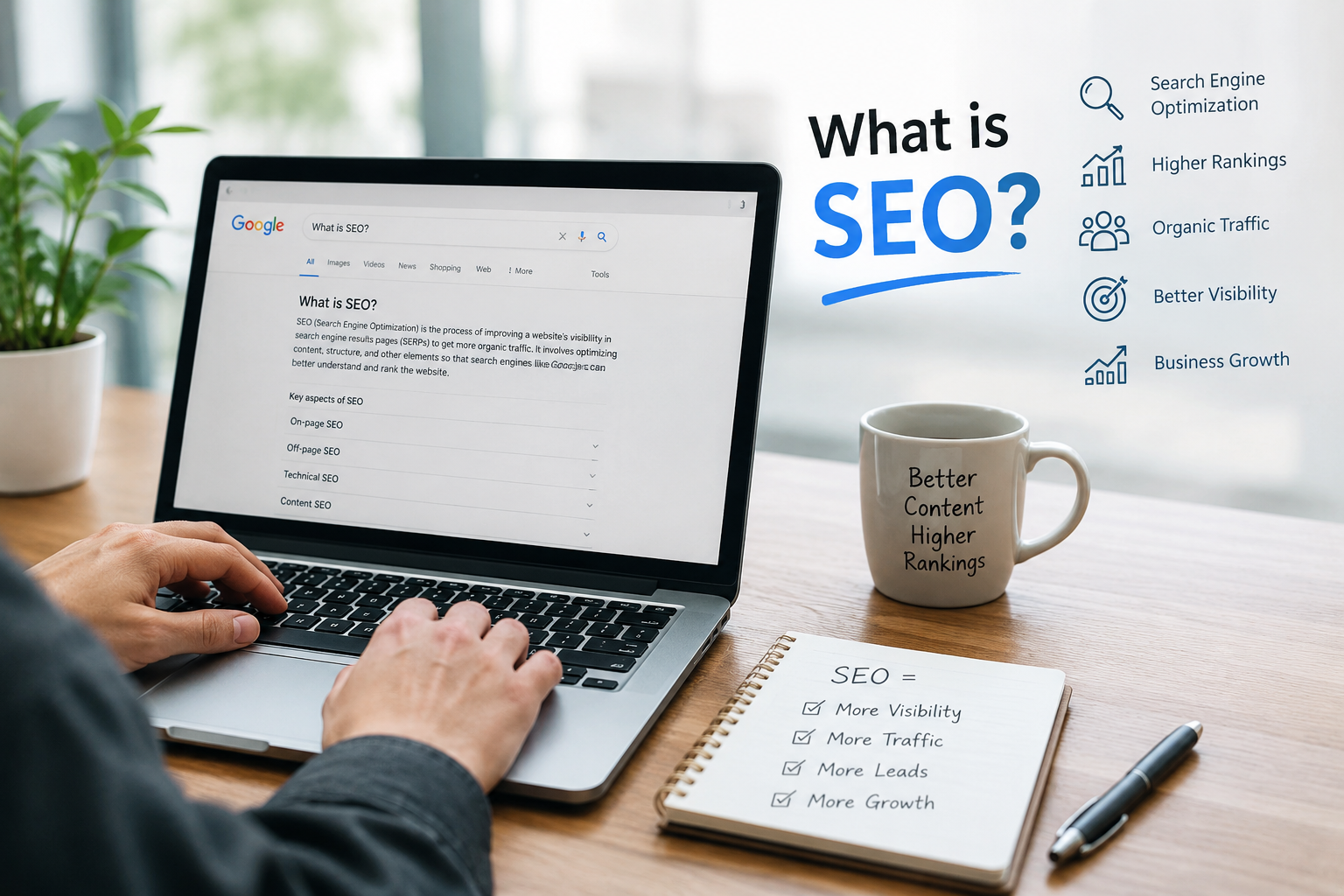
If you’ve ever typed something into Google and wondered why certain websites show up on page one while others are buried on page five, you’ve already brushed shoulders with SEO — whether you knew it or not. So, what is SEO, really? Let’s break it down in plain, simple words, without the confusing jargon most articles throw at you.
Thank you for reading this post, don’t forget to subscribe!At Digital Growth Lab Pro, we work with businesses every day who ask the same honest question: “We built a website, so why isn’t anyone finding it?” The answer almost always comes back to SEO. This guide will walk you through exactly what it is, how it works, and why it’s worth your time — even if you’re starting from zero.
What is SEO in Simple Words?
SEO stands for Search Engine Optimization. In the simplest sense, it’s the practice of shaping your website so that search engines like Google, Bing, or Yahoo understand what your page is about — and trust it enough to show it to people searching for related topics.
Think of Google as a massive librarian sorting through billions of books (websites). When someone asks a question, the librarian doesn’t just hand over any random book. It picks the ones that are well-organized, genuinely useful, and easy to read. SEO is the process of making your website that well-organized, trustworthy book the librarian wants to recommend.
No amount of luck gets you there. It’s a mix of technical setup, quality content, and credibility signals — all working together.
Why Does SEO Actually Matter?
Here’s something a lot of business owners don’t realize until it’s too late: most people never scroll past the first page of Google results. If your website isn’t showing up there, it’s almost invisible — no matter how good your product or service actually is.
A few real reasons SEO matters:
- Free, ongoing traffic – Unlike ads, SEO doesn’t stop working the moment you stop paying.
- Builds trust – People naturally trust websites that rank higher, even if they don’t consciously realize why.
- Better user experience – Good SEO practices also make your website faster and easier to use, which keeps visitors around longer.
- Long-term growth – A well-optimized page can keep bringing in visitors for months or years after it’s published.
The Three Main Types of SEO
SEO isn’t just one single task — it’s really three different areas working side by side.
1. On-Page SEO
This covers everything you directly control on your own website: your titles, headings, content quality, images, internal links, and how naturally your keyword appears throughout the page. This is usually the starting point for beginners because it’s the most within your control.
2. Off-Page SEO
This is about building your website’s reputation outside of your own pages — mainly through backlinks (other trustworthy websites linking to yours), social signals, and brand mentions. In Google’s eyes, if respected websites are referencing yours, you must be offering something valuable.
3. Technical SEO
This is the behind-the-scenes engine work — site speed, mobile-friendliness, secure connections (HTTPS), clean site structure, and making sure search engines can actually crawl and index your pages without running into errors.
All three need attention. Focusing on just one and ignoring the others is like decorating a house beautifully while ignoring a leaking roof — it won’t hold up for long.
How Does SEO Actually Work?
Search engines use automated programs called crawlers (or bots) that constantly scan the internet, reading through websites and storing that information in a giant database called an index. When someone types a search query, the search engine scans its index and ranks pages based on hundreds of factors — relevance, quality, loading speed, mobile usability, backlinks, and overall trustworthiness, to name a few.
The goal of SEO is simple: send the right signals so search engines clearly understand what your page offers, and rank it fairly against similar competing pages.
Common SEO Mistakes Beginners Make
Even well-meaning website owners fall into these traps:
- Stuffing keywords unnaturally into content just to “please Google”
- Ignoring mobile users, even though most searches now happen on phones
- Publishing content without proper research on what people are actually searching for
- Skipping meta titles and descriptions entirely
- Expecting overnight results (SEO is a long game, not a quick fix)
How Long Does SEO Take to Show Results?
This is one of the most common questions we get at Digital Growth Lab Pro, and honestly, we won’t sugarcoat it: SEO is not instant. Depending on your competition and consistency, noticeable results typically take anywhere from 3 to 6 months, with stronger, more stable growth often building over 6 to 12 months.
The businesses that win with SEO aren’t necessarily the ones with the biggest budgets — they’re the ones who stay consistent and keep improving month after month.
The Bottom Line on SEO
So, to circle back to our original question — what is SEO? It’s the practice of making your website genuinely easier for search engines to understand and for real people to trust. It’s not a trick or a shortcut; it’s a long-term investment in making your online presence visible to the people already searching for what you offer.
If your website has been sitting quietly with barely any visitors, it might not be because your business lacks value — it might simply be that search engines haven’t found a reason to recommend you yet. And that’s a fixable problem, one that Digital Growth Lab Pro helps businesses solve every single day.
